The 1971 Postal Strike

Introduction

The first full national strike in the history of the British Post Office took place from Wednesday 20th January to Sunday 7th March 1971. It took place against a background of increasing inflation and worsening industrial relations over the preceding decade, both in the Post Office and in the country in general. On 15th January a pay offer from the Post Office Board was rejected by the executive of the Union of Post Office Workers. An "all-out" strike was called to start at midnight on 19th/20th January.

Although local mail deliveries were possible in some areas, either where the postmen did not go on strike or as some gradually returned to work, the bulk of the country's postal services came to a complete halt.

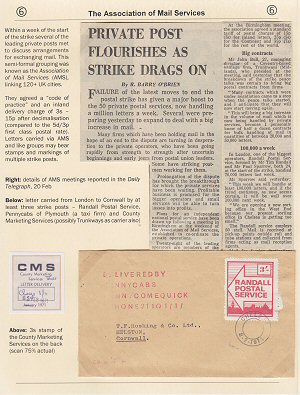
The Government announced that the Post Office's monopoly on carrying letters would be suspended for the duration of the strike. Several hundred private posts were set up throughout the country; some of these were of course "philatelic", but many operated with efficiency and transported significant quantities of mail, although normally at a much higher price than the normal first class rate. A number of these posts linked up in an "Association of Mail Services" which provided for transmission of letters from post to post across the country, and also to overseas destinations. Considerable use was also made of the existing alternatives, and of course the Armed Forces had their own postal arrangements.

The strike dragged on for seven weeks as the Union and the Post Office were unable to agree. Eventually, faced with rapidly worsening finances, the Union Executive proposed a public enquiry as a peace plan to Employment Secretary Robert Carr. A ballot resulted in a majority for ending the strike, and postmen were told to return to work at 9am, Monday 8th March.

The disruption of services caused by the strike produced a wide range of interesting material. Much is rarer than a "Post Office Mauritius" -- and while it may not have the same 'philatelic pedigree', arguably it has much greater postal significance, as these items represent the only services available for a major country for a seven week period, longer than the Uniform 4d Post!

This exhibit gives an overview of the background to the strike and its progress, and looks at the postal and social aspects of the ways in which the UK kept communications going in early 1971. It won a large vermeil and the Social Philately Trophy at the Torquay 2006 national exhibition.


Frame 1

  1. Introduction
  2. The Post Office Unions
  3. The 1962 and 1964 Strikes
  4. All-Out Strike Called for 20th February 1971
  5. The Strike Begins - Mail Becomes Undeliverable
  6. Commencement of the Strike
  7. Public Relations
  8. See sheet 7
  9. Closure of Posting Boxes
  10. The February Stalemate
  11. The Sub-Post Office Network
  12. See sheet 11
  13. The Strike Ends
  14. The UPW Hospital Service
  15. Mail Carried by Striking Postmen
  16. See sheet 15

Frame 2

  1. Local Letter Deliveries by Staff Not on Strike
  2. See sheet 17
  3. Growing Availability of Post Office Services
  4. See sheet 19
  5. Use of Existing Alternatives to the Post
  6. See sheet 21
  7. Railway Services for Letters and Parcels
  8. See sheet 23
  9. Private Strike Posts
  10. The Randall Postal Service
  11. The Problems of Private Postmen
  12. See sheet 27
  13. Increase in Mail for Private Posts
  14. See sheet 29
  15. Strike Post Rate Handbills
  16. See sheet 31

Frame 3

  1. Press Coverage
  2. Small-Scale Strike Posts
  3. Strike Posts with Political Motivations
  4. London Strike Posts
  5. Distribution of Strike Posts
  6. See sheet 37
  7. The Association of Mail Services
  8. Trunkways - The Chief Private Carrier
  9. Alternative Deliveries
  10. Mails To and From Official Bodies
  11. Arrangements For Strike Post Linkages
  12. See sheet 43
  13. Mail Handled By Multiple Strike Posts
  14. See sheet 45
  15. Mail Embargoed by Foreign Post Offices
  16. Mail to Overseas via Strike Posts

Frame 4

  1. Dromoderry and Randall Postal Services Overseas Mail
  2. See sheet 49
  3. Covering the World
  4. See sheet 51
  5. Bringing Mail Back to the UK
  6. See sheet 53
  7. Special Mail Arrangements of Foreign Post Offices
  8. See sheet 55
  9. Mail Handled by the Armed Forces
  10. Despatch of Forces Mail
  11. See sheet 58
  12. Civilian Mail Carried by Forces Postal Services
  13. The Return to Work
  14. The Backlog of Private Post Mail
  15. Lack of Facilities for Special Postings
  16. Postscript A Year Later