(link)
Frame 1
Introduction
- General Introduction
Chapter 1. Prior to 6 May 1840
- Introduction
- The Mercantile Committee's Proposal for Obliterating Adhesives
- See sheet 3
- James Chalmers' Proposed Method of Obliteration
- Letter from Bokenham to Maberley - The Earliest Known Use of the Maltese Cross
- The April 1840 Postmasters Notice and the Earliest Recorded Postal Use of the Maltese Cross
- See sheet 7
- The Manufacturer of the Maltese Cross - Sampson Mordan & Co. Price List 1st October 1842
Chapter 2. First Day and Other Early Usages
- Introduction
- No Maltese Cross Applied on Letter Paid in Cash
- First Day Usage Referring to New Means of Paying Postage
|
(link)
Frame 2
Chapter 2. First Day and Other Early Usages (cont)
- First Official Day of Use - London Inland Office and Twopenny Post Office, Provincial Office
- See sheet 13
- Contemporary Adverse Comment
- Within the London Suburbs - Kingston 7 May 1840
- Unnecessary and Unofficial Use
- Contrary to Regulations
- Black Obliterating Ink
- Black Obliterating Ink (Cancelling Charge Mark)
- Maltese Cross Omitted
- Within the London Suburbs - Edgware 11 May 1840
Chapter 3. The Change of Obliterating Ink Colour
- Introduction
- Unofficial Early use of Black Obliterating Ink
|
(link)
Frame 3
Chapter 3. The Change of Obliterating Ink Colour (cont)
- Thomas Watson's Experiments - Manuscript 'V' Cancellation: October 1840
- Rowland Hill's Report on the Obliteration of Postage Stamps 17 September 1840
- See sheet 26
- Thomas Watson's Experiments to Remove Maltese Cross Obliterations 8 November - 12 December 1840
- National Bank of Ireland Stamp
- See sheet 26
- See sheet 26
- The First Day of Experimental Use of Black Obliterating Ink
- Within the London Suburbs: Unofficial Early Use of Black Obliterating Ink
- Within the London Suburbs: Continued Use of Red Obliterating Ink During the Official Trial of Black Ink at the Chief Office
- Within the London Suburbs: First Official Day of Use of Black Obliterating Ink
- Within the London Suburbs: Latest Known Use of Red Obliterating Ink
|
(link)
Frame 4
Chapter 3. The Change of Obliterating Ink Colour (cont)
- Claim for Reimbursement of the Cost of the Red Obliterating Ink
- See sheet 37
- London Inland Office - Last Day of Use of Red Ink
- London Inland Office - First Day of Use of Black Ink
- Statistics - English Provinces and Wales
- Transition from Red to Black Ink - Manchester
- Continued Use of Red Ink at Derby
- Earliest Recorded Official Use of Black Ink Outside London
- Transition from Red to Black Ink - Leeds
- Late Use of Red Ink at Ravenglass
- Transition from Red to Black Ink - Stourbridge
- Statistics - Scotland
|
(link)
Frame 5
Chapter 3. The Change of Obliterating Ink Colour (cont)
- Transition from Red to Black Ink - Edinburgh
- The Official Introduction of Black Obliterating Ink in Scotland - Notice to Postmasters
- See sheet 50
- Statistics - Ireland
- Late Transitional Use of Red Ink in Ireland - Newry
- Earliest Official Use of Black Ink - Dublin and Continued Use of Red Ink - Mallow
- Unofficial Late Use of Red Ink - Great Heywood (under Rugely)
- Unofficial Late Use of Red Ink - Chumleigh and Southport
- Unofficial Late Use of Red Ink - Redcar
- Unofficial Late Use of Red Ink - Omagh
- Unofficial Late Use of Red Ink - London Foreign Office (1)
- Unofficial Late Use of Red Ink - London Foreign Office (2)
|
(link)
Frame 6
Chapter 4. Unofficial Ink Colours and Combinations
- Introduction
- Brown and Black Ink Combination - Glasgow
- Red and Black Ink Combination During the 'Red Ink' Period
- Red and Black Ink Combination During the 'Black Ink' Period
- Blue and Black Ink Combination - Cookstown
- Blue and Red Ink Combination - Settle
- Different Red Ink Compositions on the Same Cover
- Mixed Red and Black Inks
- Part Black and Part Blue Maltese Cross
- Pink and Ruby Ink
- Unusual Red Ink Compositions: Village Crosses
- Crosses Struck in Unusual Ink Shades
|
(link)
Frame 7
Chapter 4. Unofficial Ink Colours and Combinations (cont)
- Blue Ink - Ambleside
- Blue Ink - Lancaster and Truro
- Blue Ink - Continental Mail
- Blue Ink - Allonby
- Blue Ink - Preston
- Black Maltese Cross of Preston
- Blue-Green Maltese Cross of Preston
- Blue Ink - Preston
- Magenta Maltese Cross - Preston
- The 'Lord Holland' Original Wrapper and Facsimile
- See sheet 82
- The Myth of the 'Oxidised' Cross
|
(link)
Frame 8
Chapter 4. Unofficial Ink Colours and Combinations (cont)
- Brown Ink - East Kilbride (Glasgow) and Wenlock
- 'White' Obliterating Ink of Cirencester
- Vermilion and Purple Ink
- Green Ink - Moate
- Olive Green Ink - Brentford
- Greenish Crosses - Rushyford and Rugby
- Unusual Red Ink Compositions - Solid Orange Crosses, Kingstown and Glasgow
- Unusual Red Ink Compositions - Oily Composition of Boston
- Unusual Shades of the Official Colours - Bright Scarlet of Hounslow and Grey of Turnham Green
Chapter 5. The Inland Office Numbered Series
- Introduction
- First Day of Use - No 2 in Cross
- First Day of Use - No 7 in Cross
|
(link)
Frame 9
Chapter 5. The Inland Office Numbered Series (cont)
- First Day of Use - No 3 in Cross, The Earliest Known Use of Any Numbered Cross
- First Day of Use - No 4 in Cross
- First Day of Use - No 8 in Cross
- First Day of Use - No 7 in Cross
- First Day of Use - No 9 in Cross
- Continued Use of Common Crosses - 18th March 1843
- Continued Use of Common Crosses - 28th March 1843
- Re-Introduction of the Generic Cross - Earliest Recorded Use
- Numbered Cross Used in Conjunction with a Common Cross
- Unusual Usages - Albino Penny Pink and Sunday Datestamp Cover
- Unusual Usages - Double Strikes of Numbered Crosses
- Unusual Usages - No 12 Cancelling Single Adhesive and No 3 with Constant Blemish
|
(link)
Frame 10
Chapter 5. The Inland Office Numbered Series (cont)
- Unusual Usages - Numbered Crosses on Re-Directed Mail
Chapter 6. Alexander Kirkwood and Son Designs
- Introduction
- Summary of Kirkwood Crosses in the Company Records
- Kirkwood Records Continued
- Edinburgh
- Dumfries
- Alexandria
- Greenock
- Dumfries Distinctive Cross with Retained Debris
- Kelso
- Kelso
- Greenock
|
(link)
Frame 11
Chapter 7. Other Scottish and Irish Unusual Crosses
- Introduction
- Mullingar and Ross
- Early Correspondence Regarding the Shape of Irish Crosses: J.B.Seymour
- See sheet 123
- Tallow
- Belfast and Cork
- Knocktopher
- Dunnet Manuscript Maltese Cross
- Kilmarnock
- Arbroath and Stirling
- Perth
- Double Lined Cross, Campbelton
|
(link)
Frame 12
Chapter 8. English and Welsh Unusual Crosses
- Introduction
- York
- Manchester Fishtail
- Coventry Type 1
- Coventry Type 2
- Leeds
- Brighton
- Norwich and Leamington
- Alresford
- Crosses with Constant Breaks - Cirencester and Kendal
- Crosses with Constant Breaks - London 'Broken Points' Cross
- Crosses with Constant Breaks - Newcastle under Lyne
|
(link)
Frame 13
Chapter 8. English and Welsh Unusual Crosses (cont)
- Plymouth
- Whitehaven
- Wotton-under-Edge
- Small Number in Cross
- Dublin Small '1' in Cross
- Solid Centred Crosses - Shrewsbury and Birmingham
- Solid Crosses - Lawton and Markinch
- Solid Outer Crosses - Kington and Thornhill
- Solid Centred Cross - Cove
- Whitehaven Common Cross
- Coleford
- Clitheroe
|
(link)
Frame 14
Chapter 9. Unusual Usages
- Introduction
- Adhesives Used as a Seal: The Public Campaign, Post Office Policy and the Vigilance of its Clerks
- See sheet 158
- Single Maltese Cross Cancelling Two Adhesives
- Maltese Cross Omitted - to Sir Edward Lees
- Maltese Cross Omitted
- Multiple Strikes of the Cross
- Additional Strikes of the Cross
- Accidental Usage
- Stampless Covers To or From Overseas
- Stampless Covers
- Spilsby Double Strike
|
(link)
Frame 15
Chapter 9. Unusual Usages (cont)
- Mulready Caricatures
- Used to Obliterate Another Mark
Chapter 10. London Suburban Use of the Maltese Cross
- Introduction
- Mail to be Delivered Along the Same Ride or Local Mail
- Mail Transferred to the General Post Without Passing Through the Chief Office
- Mail Transferred to the General Post Without Passing Through the Chief Office
- Mail Transferred to the General Post or Via London
- Mail to be Delivered Along the Same Ride
- Mail Transferred to the General Post
- Maltese Crosses of Hounslow and Barnet
- Mail to be Delivered Along the Same Ride or Via London
- Continued Use of Red Obliterating Ink During the Official Trial of Black Ink at the Chief Office
|
(link)
Frame 16
Chapter 10. London Suburban Use of the Maltese Cross (cont)
- Mail to be Delivered within the Vicinity of the Office
Chapter 11. Dissatisfaction with the Obliterator
- Introduction
- The Times, 10 May 1844: 'New Obliterating Stamp at the Post Office'
- Attempted Fraudulent Re-Use of An Adhesive
- Stamp Fallen Off
- Rowland Hill's Report on the Obliteration of Postage Stamps, September 1840
- See sheet 186
- Stamp Fallen Off
- Successful Attempt to Mitigate Loss of an Adhesive
- See sheet 186
- See sheet 186
- Attempt to Mitigate Loss of an Adhesive
|
(link)
Frame 17
Chapter 12. Replacement of the Obliterator
- Introduction
- Transition to Numeral Obliterators - Liverpool
- Transition to Numeral Obliterators - Birmingham
- First Day of Use of Numeral Obliterators - Bradford
- Continued Use of the Maltese Cross - Darlington
- Continued Use of the Maltese Cross - Brecon
- Continued Use of the Maltese Cross - Newcastle upon Tyne
- Continued Use of the Maltese Cross - Liskeard
- Transition to Numeral Obliterators - London Inland Office
- Transition to Numeral Obliterators - London Inland Office
- Transition to Numeral Obliterators - London Inland Office
- Transition to Numeral Obliterators - London District Post Office
|
(link)
Frame 18
Chapter 12. Replacement of the Obliterator (cont)
- Last Known Use at a London Suburban Office
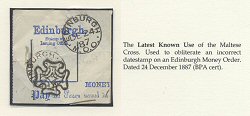
- Continued Use of the Maltese Cross - Edinburgh
- Continued Use of the Maltese Cross - Glasgow
- Continued Use of the Maltese Cross - Glasgow
- Concurrent Use of Maltese Cross and Numeral Obliterator
- Continued Use of the Maltese Cross - Dublin
- Combination of Last Day Maltese Cross and First Day Numeral on Same Cover
Chapter 13. Late Use of the Maltese Cross
- Introduction
- Adhesives Printed After the Obliterator Had Been Generally Replaced
- See sheet 213
- Plates Registered After 1844 - 1d red Imperf Alphabet I
- Castle Cary
|
(link)
Frame 19
Chapter 13. Late Use of the Maltese Cross (cont)
- Edinburgh Area - Costorphine
- Edinburgh Area - Costorphine
- Edinburgh Combinations
- Edinburgh Area - Cramond
- Edinburgh Area - Currie
- Edinburgh Area - Currie
- Edinburgh Area - Roslin
- Edinburgh Area - Roslin
- Edinburgh Area - Granton Pier
- Edinburgh Area - Ratho
- Edinburgh Area - Chirnside
- Edinburgh Area - West Salton
|
(link)
Frame 20
Chapter 13. Late Use of the Maltese Cross (cont)
- Milnthorpe Area - Backbarrow
- Milnthorpe Area - Backbarrow
- Milnthorpe Combinations
- Milnthorpe Combinations
- Milnthorpe Area - Penny Bridge
- Milnthorpe Area - Penny Bridge
- Milnthorpe Area - Newby Bridge
- Milnthorpe Area - Newby Bridge
- Milnthorpe Area - Newby Bridge Combination
- Milnthorpe Area - Overcancelling of a Numeral Obliterator
- Milnthorpe Area - Overcancelling of the Maltese Cross
- Padiham, under Blackburn
|
(link)
Frame 21
Chapter 13. Late Use of the Maltese Cross (cont)
- Padiham, under Blackburn
- Padiham, under Blackburn
- Kirkwall Combinations
- Much Wenlock
- Chapeltown (under Sheffield)
- Perforated Issues - Ramsbury, Maltby, Waltham and Ivinghoe
- See sheet 246
- Gargrave
- Llannerchymedd
- Llannerchymedd in Official Period
- Aberffraw
- Aberffraw
|
(link)
Frame 22
Chapter 13. Late Use of the Maltese Cross (cont)
- The 'Whitehaven' Maltese Cross used at Egremont
- Ballylongford
- The Green-Blue Crosses of Ivinghoe and Leeds
- Ivinghoe - Blue Obliterating Ink
- Echt - Blue Obliterating Ink
- Echt (under Aberdeen)
- Wolsingham and Padiham - Blue Obliterating Ink
- Used as a Backstamp - Downton
- Bruton - Olive Obliterating Ink on Late Fee Cover
- Used as Instructional Mark - to Obliterate Incorrect Postmark and as a 'Missent To' Mark
- Chapeltown and Newby Bridge - 6d Postage Rates
- Maltby - A Cursed Royal Letter
|

 SHOW MENU